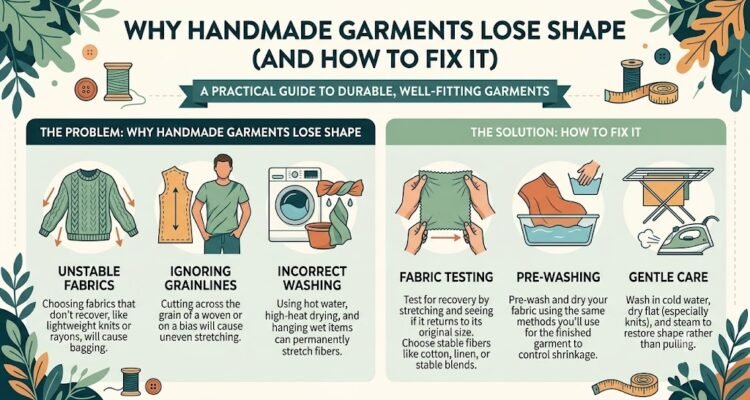
Why Handmade Garments Lose Shape (And How to Fix It)

Why Handmade Garments Lose Shape (And How to Fix It)

Introduction

Many handmade garments look excellent when finished but lose their shape after only a few washes. In my own sewing practice, I’ve seen this happen most often with beginners who skip fabric testing entirely. Usually it isn’t a sewing skill problem, it’s a fabric problem. Durability starts before the first cut. Choosing the right fabric and preparing it correctly keeps handmade garments fitting well over time.

Quick Summary

Shape retention depends on three things:

  • The fabric itself
  • How it’s prepared
  • How it’s sewn

Stable fabrics, correct prewashing, and matching fabric to pattern all help handmade garments last.

Why Fabric Durability Matters

  • Everyday wear. A garment that sags or stretches quickly becomes unwearable, no matter how well it’s sewn.
  • Saves time and money. Remaking a stretched-out garment costs more than choosing the right fabric upfront.
  • Looks good does not mean it lasts long. A garment can look perfect off the machine and still fail within weeks.

A real example: I once sewed two identical fitted t-shirts from the same pattern, using two different cotton-spandex blends. One held its shape for over a year of weekly wear. The other stretched out at the neckline and hem within three washes. The only difference was fibre recovery, the fabric’s ability to return to its original size after being stretched. That single test changed how I choose knit fabric for every project since.

Lesson learned: never trust a fabric’s feel alone. A knit can feel firm on the bolt and still have poor recovery once it’s cut, sewn, and washed repeatedly.

What “Fabric Recovery” and “Dimensional Stability” Actually Mean

Two terms come up constantly in fabric durability, and it’s worth defining them plainly:

  • Recovery is how well a fabric snaps back to its original shape after being stretched. Low recovery means the fabric stays stretched out.
  • Dimensional stability is how well a fabric resists shrinking, growing, or twisting during washing and wear. Poor stability shows up as a garment that fits differently after laundering than it did off the sewing machine.

Understanding these two properties is the single biggest factor in predicting whether a handmade garment will hold its shape.

Common Reasons Garments Lose Their Shape

  • Low fabric recovery (stretches but doesn’t spring back)
  • Poor dimensional stability
  • Skipping prewashing
  • Wrong fabric for the pattern
  • Incorrect washing and drying

How Fabric Construction Affects Durability

  • Woven fabrics. Interlocking threads resist distortion and generally hold shape well.
  • Knit fabrics. Rely on fibre elasticity; poor recovery causes sagging at elbows and knees.
  • Fabric weight. Lightweight fabrics wear thin faster than mid-weight fabrics suited to the garment’s use.
  • Fibre blends. Synthetic blends often resist shrinkage and improve recovery compared with 100% natural fibres.

According to textile testing guidelines published by the American Association of Textile Chemists and Colorists (AATCC), fabric dimensional change is one of the standard measures used to evaluate garment performance after laundering, which is why prewashing test swatches before cutting mirrors how the textile industry itself checks fabric reliability.

What to Check Before Buying Fabric

  • Returns to shape after stretching
  • Even fabric density
  • Suitable weight for the pattern
  • Minimal surface pilling
  • Care instructions match intended use
  • Fibre content suits the project

Sewing Decisions That Improve Longevity

  • Prewash before cutting
  • Follow the correct grainline
  • Use the right needle and thread
  • Reinforce high-stress seams
  • Match fabric to pattern design

Woven vs Knit: Shape Retention

Feature Woven Knit
Shape stability Higher Depends on recovery
Stretch Minimal Natural
Recovery Limited Varies by fibre
Best for Structured garments Everyday comfort wear

How I Test Fabric Before Starting Any Project

This is the exact process I use before cutting into new fabric, and one I teach in my own classes:

  • Stretch recovery test. Stretch a swatch by hand and time how long it takes to return to size. Under a few seconds is a good sign; if it stays stretched, the fabric will likely sag in the finished garment.
  • Wrinkle recovery test. Crush a swatch in your fist for ten seconds, then release. Fabric that smooths out quickly resists creasing in wear.
  • Light transparency test. Hold the fabric up to light to check weave or knit density; too much light through means thin, less durable fabric.
  • Density check. Feel across the swatch for thin or uneven patches, common in lower-quality bolts.
  • Prewash test. Wash and dry a swatch the way you’ll care for the finished garment, then measure it against the original size to catch shrinkage before cutting.

Choosing Fabric That Lasts

  • Match fabric to the garment’s purpose
  • Balance comfort with durability
  • Buy from trusted suppliers
  • Use wovens for structured, tailored pieces
  • Use knits for stretch-dependent comfort wear

Conclusion

Long-lasting handmade garments start with the right fabric, proper prep, and suitable care. In my experience, the five-minute swatch test saves hours of remaking garments later. Choose and test fabric carefully, and your handmade garments will hold their shape for years, not just a few washes.

FAQs

Why do handmade garments lose their shape after washing? Usually low fabric recovery, poor dimensional stability, or skipping prewashing.

Which fabrics last longest in handmade clothing? Fabrics with good recovery, correct weight, and stability for the pattern.

Are woven fabrics more durable than knits? Generally yes. Wovens hold structure better; knits depend on fibre recovery.

Does prewashing improve durability? Yes. It removes shrinkage risk before the garment is sewn.

How do I stop handmade clothes from stretching out? Choose fabric with strong recovery, follow the grainline, and reinforce stress points.

What should I check before buying fabric? Recovery, shrinkage, pilling resistance, density, and care requirements.

For more information, visit Maaidesign.

leave your comment


Your email address will not be published. Required fields are marked *