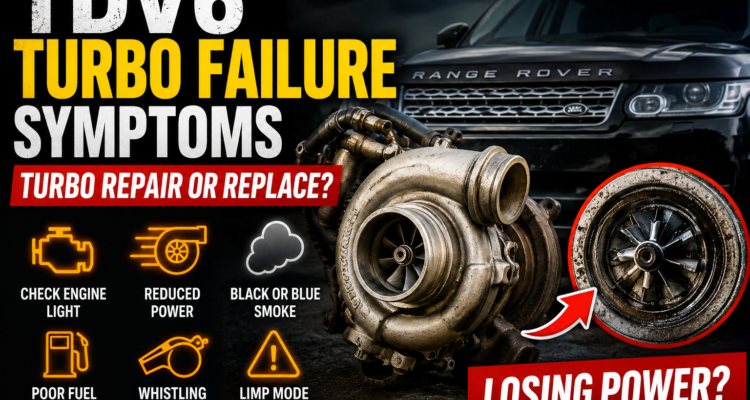
TDV6 Turbo Failure Symptoms — Turbo Repair or Replace, Losing Power

TDV6 Turbo Failure Symptoms — Turbo Repair or Replace, Losing Power

Introduction: The TDV6 Turbo — What Goes Wrong and Why It Matters

The Land Rover and Range Rover TDV6 engine is one of the most widely used diesel powerplants in the JLR lineup. Fitted across the Range Rover Sport, Range Rover Vogue, Discovery 3, and Discovery 4, this engine has earned a strong reputation for performance and refinement. However, TDV6 turbo failure symptoms are among the most commonly reported issues by owners — and when they appear, acting quickly can mean the difference between a straightforward turbo repair and a full engine rebuild.

At RR Engine Works, specialist Range Rover engine specialists based in Grays, Essex, the team deals with TDV6 turbo failure symptoms on a regular basis. In this guide, we’ll walk through the warning signs, explain what causes them, and help you decide whether turbo repair or replacement is the right course of action for your vehicle.

What Is the TDV6 Turbocharger and Why Does It Fail?

The Range Rover TDV6 engine uses a variable-geometry turbocharger (VGT) to deliver strong performance across a wide rev range. This system relies on a series of moving vanes that adjust airflow into the turbine housing — improving low-end torque and top-end power simultaneously. It is a sophisticated piece of engineering, but it is also one of the components most prone to carbon build-up and mechanical wear over time.

When the vanes become sticky or the actuator fails, TDV6 turbo failure symptoms begin to emerge — often gradually at first, before becoming more pronounced and serious. Ignoring these symptoms risks secondary damage to the engine, making the question of turbo repair or replace far more expensive to answer.

TDV6 Turbo Failure Symptoms — Know the Warning Signs

Understanding TDV6 turbo failure symptoms early gives you the best chance of resolving the issue before it escalates. Here are the most common signs that your TDV6 turbocharger is failing:

1. Losing Power Progressively

One of the most frequently reported TDV6 turbo failure symptoms is a noticeable loss of power — particularly when accelerating from low speeds, overtaking, or climbing hills. If your Range Rover or Discovery feels sluggish where it once felt strong, the turbocharger is a primary suspect. Losing power in a TDV6 is almost always linked to reduced boost pressure, which is the turbocharger’s primary job to deliver.

2. Black or Blue Smoke from the Exhaust

Excessive black smoke on acceleration is a classic sign of over-fuelling without sufficient air — a direct indicator of TDV6 turbo failure symptoms related to reduced boost. Blue smoke, on the other hand, suggests oil is being burned in the combustion chamber — which can indicate the turbocharger seals have failed, allowing oil to pass into the intake system.

3. Whining, Whistling, or Grinding Noises

A healthy turbocharger runs smoothly and quietly. If you notice a high-pitched whine, a whistling sound under boost, or a grinding noise from the engine bay, these are serious TDV6 turbo failure symptoms that warrant immediate inspection. Bearing wear, compressor wheel damage, and turbine housing cracking can all produce these sounds.

4. Increased Oil Consumption

If you find yourself topping up the engine oil more frequently than usual, oil is likely escaping through a failing turbo seal. This is one of the more insidious TDV6 turbo failure symptoms because it can appear minor at first — but the oil passing through the turbo eventually ends up in the intake, intercooler, and combustion chamber, causing progressive damage.

5. EML Light and Boost Pressure Fault Codes

A dashboard Engine Management Light (EML) combined with fault codes relating to boost pressure, turbo actuator position, or MAF sensor readings is a strong indicator of TDV6 turbo failure symptoms. Modern JLR vehicles monitor turbocharger performance closely, and the ECU will flag deviations from expected boost levels. RR Engine Works uses professional-grade diagnostics to read and interpret these codes accurately.

6. Limp Mode

Severe TDV6 turbo failure symptoms often trigger the vehicle’s limp mode — a protective state in which the ECU limits engine output to prevent catastrophic damage. If your Range Rover or Discovery enters limp mode and restricts you to low speeds, turbocharger failure is one of the most common root causes. Losing power to this extent requires urgent diagnosis.

What Causes TDV6 Turbo Failure?

Understanding why TDV6 turbo failure symptoms develop helps prevent future problems after a repair or replacement. The most common causes include:

  • Carbon build-up on VGT vanes — Particularly in vehicles used predominantly on short urban journeys, carbon deposits restrict the vanes and cause poor boost regulation.
  • Oil starvation — If the oil supply to the turbocharger is disrupted — due to a blocked oil feed pipe or neglected oil changes — bearing wear accelerates rapidly.
  • Contaminated oil — Using incorrect oil grades or leaving engine oil unchanged for too long introduces deposits that damage the turbocharger’s internal bearings.
  • Over-revving on cold start — Driving hard before the oil has fully circulated puts extreme stress on turbo bearings.
  • Coolant leaks into the engine — EGR cooler failure, which is a known TDV6 weakness, can allow coolant into the oil, reducing lubrication quality and accelerating turbo wear.

Turbo Repair or Replace — Which Is Right for Your TDV6?

This is the question every TDV6 owner facing these symptoms eventually asks: is turbo repair or replace the better option? The answer depends on the specific nature of the failure and the overall condition of the engine.

When Turbo Repair Makes Sense

Turbo repair or replace decisions tend to favour repair when:

  • The VGT vanes are simply sticky with carbon deposits and can be cleaned and reconditioned
  • The actuator has failed but the turbo housing and impeller are undamaged
  • Bearing play is minimal and the compressor wheel shows no signs of contact wear
  • The rest of the engine is in good health

In these cases, a professional turbo recondition or actuator replacement is a cost-effective solution that restores full boost performance without the expense of a full replacement unit.

When Replacement Is the Better Choice

Turbo repair or replace decisions lean toward full replacement when:

  • The compressor or turbine wheel shows impact damage or blade erosion
  • The bearing housing is heavily worn or scored
  • Oil contamination has caused extensive internal damage
  • The turbo has failed completely, causing losing power so severe the vehicle is in permanent limp mode
  • A reconditioned unit would carry limited reliability compared to a new or remanufactured replacement

RR Engine Works carries stock of quality replacement turbochargers for TDV6 applications and can advise definitively on the turbo repair or replace question after a full diagnostic inspection.

The Cost of Ignoring TDV6 Turbo Failure Symptoms

Many owners delay addressing TDV6 turbo failure symptoms because they hope the issue will resolve itself or because they’re concerned about cost. This is understandable — but it is almost always a false economy.

When a failing turbocharger is left in service:

  • Oil passes through the turbo and coats the intake system and intercooler
  • The engine ECU may mask symptoms through adaptive fuelling, masking the true severity
  • Turbo blade fragments can enter the engine, causing catastrophic piston and bore damage
  • Losing power becomes progressive and eventually total
  • What could have been a turbo recondition becomes a full Range Rover TDV6 engine rebuild

RR Engine Works strongly recommends addressing TDV6 turbo failure symptoms at the earliest opportunity to prevent the situation from escalating to a full engine replacement.

Why Choose RR Engine Works for TDV6 Turbo Diagnosis and Repair?

RR Engine Works is not a general garage. As dedicated Range Rover engine specialists based in Grays, Essex, the team works exclusively on Jaguar Land Rover vehicles — meaning every technician has specific, in-depth experience with the TDV6 engine and its known failure modes.

When you bring your vehicle to RR Engine Works with suspected TDV6 turbo failure symptoms, you receive:

  • Professional JLR-level diagnostics — Full fault code reading and live data analysis using specialist diagnostic equipment
  • Physical turbo inspection — Shaft play measurement, vane condition assessment, compressor and turbine inspection
  • Honest advice on turbo repair or replace — A clear, no-pressure recommendation based on what the vehicle actually needs
  • Quality parts — OEM or OEM-equivalent turbochargers and components
  • Competitive, transparent pricing — No hidden costs or inflated labour charges

RR Engine Works also offers complete used Range Rover engines UK supply and fitting services, meaning that if your TDV6 turbo failure has already caused significant engine damage, the team can source and fit a replacement engine unit efficiently.

How RR Engine Works Diagnoses TDV6 Turbo Failure

The diagnostic process at RR Engine Works for suspected TDV6 turbo failure symptoms follows a structured, logical approach:

  1. Initial Fault Code Scan — Identifying any stored or pending ECU codes related to boost pressure, airflow, or actuator position
  2. Live Data Analysis — Monitoring real-time boost pressure, MAF readings, and actuator feedback while the engine is running
  3. Smoke and Oil Inspection — Assessing exhaust characteristics and checking for oil in the intake system or intercooler
  4. Physical Turbo Inspection — Checking shaft play, impeller condition, and VGT vane movement
  5. Road Test — Confirming symptoms under real driving conditions including load and boost demand
  6. Repair Recommendation — A clear, costed recommendation for turbo repair or replace based on findings

This systematic approach ensures that RR Engine Works identifies not just the turbocharger fault, but any contributing factors — such as oil feed blockages or EGR cooler leaks — that would otherwise cause a new or repaired turbo to fail prematurely.

Frequently Asked Questions

Q1. What are the most common TDV6 turbo failure symptoms to watch for? The most common TDV6 turbo failure symptoms include losing power under load, excessive black or blue exhaust smoke, unusual whining or whistling noises, increased oil consumption, EML warning lights with boost-related fault codes, and the vehicle entering limp mode.

Q2. Is losing power always caused by TDV6 turbo failure? Not always — losing power in a TDV6 can also result from EGR valve issues, fuel injector faults, or DPF blockages. RR Engine Works carries out a full diagnostic before confirming the cause, ensuring the correct repair is carried out.

Q3. How do I decide between turbo repair or replace for my TDV6? The turbo repair or replace decision depends on the extent of damage. RR Engine Works inspects the unit thoroughly and provides a clear recommendation — repair if the unit is salvageable, replacement if the damage is too extensive.

Q4. Can RR Engine Works supply a replacement TDV6 turbocharger? Yes. RR Engine Works stocks quality replacement turbochargers for TDV6 applications and can advise on whether a new, remanufactured, or quality used unit is most appropriate for your situation.

Q5. How long does it take to repair or replace a TDV6 turbocharger at RR Engine Works? Turnaround time at RR Engine Works varies depending on parts availability and the extent of work required, but most turbo repair or replace jobs are completed efficiently to minimise your time without the vehicle.

Q6. Will a turbo failure cause lasting engine damage if I keep driving? Yes — continuing to drive with active TDV6 turbo failure symptoms risks oil contamination of the intake system, intercooler damage, and in serious cases, ingestion of turbo blade fragments into the engine. RR Engine Works strongly advises against driving with known turbo symptoms.

Q7. Are RR Engine Works Range Rover engine specialists for all TDV6 variants? Yes. As dedicated Range Rover engine specialists, RR Engine Works works on TDV6 engines fitted to the Range Rover Sport, Range Rover Vogue, Discovery 3, Discovery 4, and other JLR models using this engine family.

Q8. What should I do if my Range Rover is losing power and entering limp mode? If your Range Rover is losing power and entering limp mode, contact RR Engine Works immediately. Do not continue driving the vehicle under load — this risks turning a repairable turbo issue into a far more costly engine repair.

Conclusion

TDV6 turbo failure symptoms are among the most common — and most consequential — issues faced by Range Rover and Land Rover owners. From early signs of losing power to full limp mode activation, these symptoms demand professional attention from specialists who truly understand the engine.

RR Engine Works offers the expertise, diagnostic capability, and honest advice needed to resolve TDV6 turbo failure symptoms efficiently and cost-effectively. Whether the answer is turbo repair or replace, the team provides a clear recommendation backed by thorough inspection — ensuring your vehicle is returned to full health without unnecessary expense.

For expert assessment of TDV6 turbo failure symptoms, trusted advice on turbo repair or replace, and quality Range Rover TDV6 engine services, contact RR Engine Works in Grays, Essex today.


leave your comment


Your email address will not be published. Required fields are marked *


news-1701

yakinjp

yakinjp

rtp yakinjp

yakinjp

yakinjp

yakin jp

yakinjp id

maujp

maujp

maujp

\

sabung ayam online

sabung ayam online

SLOT MAHJONG

sabung ayam online

article 9998000471

article 9998000472

article 9998000473

article 9998000474

article 9998000475

article 9998000476

article 9998000477

article 9998000478

article 9998000479

article 9998000480

article 9998000481

article 9998000482

article 9998000483

article 9998000484

article 9998000485

article 9998000486

article 9998000487

article 9998000488

article 9998000489

article 9998000490

article 9998000491

article 9998000492

article 9998000493

article 9998000494

article 9998000495

article 9998000496

article 9998000497

article 9998000498

article 9998000499

article 9998000500

article 9998000501

article 9998000502

article 9998000503

article 9998000504

article 9998000505

article 9998000506

article 9998000507

article 9998000508

article 9998000509

article 9998000510

article 9998000511

article 9998000512

article 9998000513

article 9998000514

article 9998000515

article 9998000516

article 9998000517

article 9998000518

article 9998000519

article 9998000520

article 9998000521

article 9998000522

article 9998000523

article 9998000524

article 9998000525

article 9998000526

article 9998000527

article 9998000528

article 9998000529

article 9998000530

article 838000468

article 838000469

article 838000470

article 838000471

article 838000472

article 838000473

article 838000474

article 838000475

article 838000476

article 838000477

article 838000478

article 838000479

article 838000480

article 838000481

article 838000482

article 838000483

article 838000484

article 838000485

article 838000486

article 838000487

article 838000488

article 838000489

article 838000490

article 838000491

article 838000492

article 838000493

article 838000494

article 838000495

article 838000496

article 838000497

article 5500226

article 5500227

article 5500228

article 5500229

article 5500230

article 5500231

article 5500232

article 5500233

article 5500234

article 5500235

article 5500236

article 5500237

article 5500238

article 5500239

article 5500240

article 5500241

article 5500242

article 5500243

article 5500244

article 5500245

article 5500246

article 5500247

article 5500248

article 5500249

article 5500250

article 5500251

article 5500252

article 5500253

article 5500254

article 5500255

article 5500256

article 5500257

article 5500258

article 5500259

article 5500260

article 5500261

article 5500262

article 5500263

article 5500264

article 5500265

article 5500266

article 5500267

article 5500268

article 5500269

article 5500270

article 5500271

article 5500272

article 5500273

article 5500274

article 5500275

article 5500276

article 5500277

article 5500278

article 5500279

article 5500280

article 5500281

article 5500282

article 5500283

article 5500284

article 5500285

article 2000256

article 2000257

article 2000258

article 2000259

article 2000260

article 2000261

article 2000262

article 2000263

article 2000264

article 2000265

article 2000266

article 2000267

article 2000268

article 2000269

article 2000270

article 2000271

article 2000272

article 2000273

article 2000274

article 2000275

article 2000276

article 2000277

article 2000278

article 2000279

article 2000280

article 2000281

article 2000282

article 2000283

article 2000284

article 2000285

article 2000286

article 2000287

article 2000288

article 2000289

article 2000290

article 2000291

article 2000292

article 2000293

article 2000294

article 2000295

article 2990356

article 2990357

article 2990358

article 2990359

article 2990360

article 2990361

article 2990362

article 2990363

article 2990364

article 2990365

article 2990366

article 2990367

article 2990368

article 2990369

article 2990370

article 2990371

article 2990372

article 2990373

article 2990374

article 2990375

article 2990376

article 2990377

article 2990378

article 2990379

article 2990380

article 2990381

article 2990382

article 2990383

article 2990384

article 2990385

article 2990386

article 2990387

article 2990388

article 2990389

article 2990390

article 2990391

article 2990392

article 2990393

article 2990394

article 2990395

article 2990396

article 2990397

article 2990398

article 2990399

article 2990400

article 2990401

article 2990402

article 2990403

article 2990404

article 2990405

article 2990406

article 2990407

article 2990408

article 2990409

article 2990410

article 2990411

article 2990412

article 2990413

article 2990414

article 2990415

article 2990416

article 2990417

article 2990418

article 2990419

article 2990420

article 2990421

article 2990422

article 2990423

article 2990424

article 2990425

article 2990426

article 2990427

article 2990428

article 2990429

article 2990430

article 2990431

article 2990432

article 2990433

article 2990434

article 2990435

article 2990436

article 2990437

article 2990438

article 2990439

article 2990440

article 2990441

article 2990442

article 2990443

article 2990444

article 2990445

article 2990446

article 2990447

article 2990448

article 2990449

article 2990450

article 2990451

article 2990452

article 2990453

article 2990454

article 2990455

article 10000286

article 10000287

article 10000288

article 10000289

article 10000290

article 10000291

article 10000292

article 10000293

article 10000294

article 10000295

article 10000296

article 10000297

article 10000298

article 10000299

article 10000300

article 10000301

article 10000302

article 10000303

article 10000304

article 10000305

article 10000306

article 10000307

article 10000308

article 10000309

article 10000310

article 10000311

article 10000312

article 10000313

article 10000314

article 10000315

article 0000331

article 0000332

article 0000333

article 0000334

article 0000335

article 0000336

article 0000337

article 0000338

article 0000339

article 0000340

article 0000341

article 0000342

article 0000343

article 0000344

article 0000345

article 0000346

article 0000347

article 0000348

article 0000349

article 0000350

article 0000351

article 0000352

article 0000353

article 0000354

article 0000355

article 0000356

article 0000357

article 0000358

article 0000359

article 0000360

article 0000361

article 0000362

article 0000363

article 0000364

article 0000365

article 0000366

article 0000367

article 0000368

article 0000369

article 0000370

article 0000371

article 0000372

article 0000373

article 0000374

article 0000375

article 0000376

article 0000377

article 0000378

article 0000379

article 0000380

article 0000381

article 0000382

article 0000383

article 0000384

article 0000385

article 0000386

article 0000387

article 0000388

article 0000389

article 0000390

news-1701