Welcome To DWT Listing Theme
-
All Locations :

Welcome To DWT Listing Theme
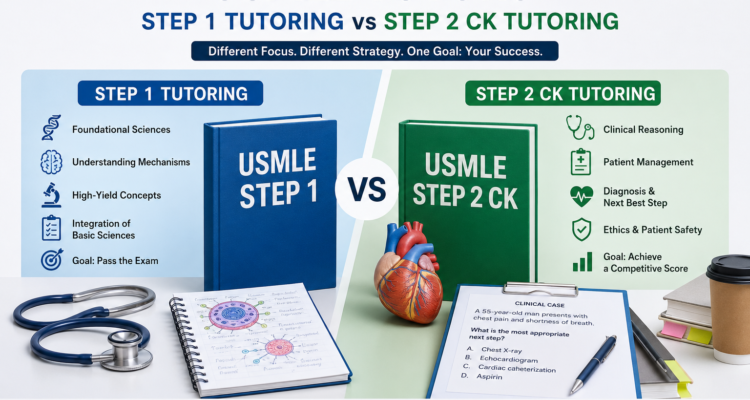
Preparing for Step 1 and Step 2 CK requires more than following the same study schedule with different resources. Although both examinations assess medical knowledge and its application, they emphasize different competencies, question-solving processes, and performance goals. Students comparing USMLE Tutors should therefore evaluate whether an instructor understands how tutoring must change between foundational science preparation and clinical decision-making.
Step 1 tutoring generally helps students integrate basic sciences, understand disease mechanisms, and build the level of competency needed to pass confidently. Step 2 CK tutoring places greater emphasis on clinical reasoning, diagnosis, management, prevention, and prioritization. A tutor who uses exactly the same teaching method for both examinations may fail to address the distinct challenges each test presents.
Understanding these differences can help medical students, MD and MBBS graduates, international medical graduates, and residency applicants choose the right form of academic support.
Step 1 assesses whether a student can understand and apply important scientific concepts related to medicine. Its content integrates subjects such as physiology, pathology, pharmacology, microbiology, immunology, biochemistry, genetics, anatomy, and behavioral science.
Since January 26, 2022, Step 1 results have been reported as pass or fail. This does not make the examination easy or unimportant. Students must still demonstrate sufficient mastery across a broad and integrated body of foundational knowledge.
Step 2 CK remains score-based and evaluates whether a candidate can apply clinical knowledge to supervised patient care. Questions commonly require the examinee to determine the most likely diagnosis, next best test, immediate intervention, definitive treatment, preventive measure, or appropriate response to an ethical situation.
The core tutoring difference can be summarized simply:
Both exams require reasoning, but the type of reasoning differs.
Effective Step 1 USMLE Tutors should help students connect scientific concepts rather than memorize thousands of isolated facts. Many struggling students have already encountered the material in medical school. Their problem is often that the information remains fragmented.
For example, a student may separately know the physiology of aldosterone, the pathology of primary hyperaldosteronism, and the mechanism of spironolactone. Step 1 questions may require those facts to be integrated within a single clinical scenario.
A USMLE Step 1 Tutor should therefore focus on several core areas.
Step 1 frequently rewards an understanding of why a disease produces a particular finding.
Rather than asking a student to memorize that a condition causes hypertension and hypokalemia, a tutor should help the student trace the underlying pathway. That process may involve hormone production, receptor activity, renal ion exchange, fluid balance, and feedback regulation.
Mechanistic teaching helps students answer unfamiliar questions because they can reason from first principles rather than depend entirely on recognition.
A single Step 1 vignette may test pathology, physiology, pharmacology, and microbiology simultaneously.
Effective tutoring should connect these disciplines within organ systems. During a cardiovascular session, for example, the tutor may integrate cardiac physiology, congenital abnormalities, vascular pathology, drug mechanisms, and clinical manifestations.
This approach is generally more useful than reviewing every subject independently without showing how the information overlaps.
Students preparing for Step 1 often accumulate too many resources. They may use multiple video platforms, textbooks, flashcard decks, question banks, lecture notes, and review courses at the same time.
A qualified tutor should help identify:
The goal is not to assign more material. It is to create a manageable system that addresses the student’s actual weaknesses.
Because Step 1 is pass/fail, the tutoring objective should be consistent readiness rather than perfection.
A tutor should examine assessment trends, subject weaknesses, question-bank performance, study consistency, and the student’s ability to reason through unfamiliar problems. One strong practice result should not automatically determine readiness, just as one disappointing score should not erase evidence of broader progress.
The decision should be based on a pattern of performance.
Step 2 CK tutoring should move beyond broad content review and focus heavily on clinical application.
A student may know the disease being described but still answer incorrectly because the question asks what should happen next. The learner must determine whether the patient needs stabilization, diagnostic testing, empiric treatment, definitive therapy, observation, screening, or reassurance.
A USMLE Step 2 Tutor should therefore emphasize the following skills.
Clinical reasoning involves organizing information into a useful diagnostic framework.
A tutor may teach the student to identify:
This approach prevents students from reacting to one familiar keyword while ignoring the rest of the case.
Step 2 CK questions often include several answers that could eventually be appropriate. The challenge is determining which action is most appropriate at that moment.
For example, a patient may need both diagnostic imaging and surgery, but unstable vital signs may require immediate resuscitation first. A suspected infection may eventually require culture confirmation, but empiric treatment may be necessary before the results are available.
Effective Step 2 CK tutoring should teach students to distinguish among:
Knowing the medicine is not enough. The student must understand the order of care.
Experienced examinees often recognize common illness patterns quickly. However, pattern recognition must be supported by evidence from the vignette.
A tutor should help the learner build illness scripts that include:
This allows the student to recognize patterns while still checking whether the facts support the conclusion.
Step 2 CK preparation should also address ethical decision-making, informed consent, confidentiality, capacity, communication, quality improvement, and patient safety.
These questions often require a different method from traditional diagnosis-based questions. The best answer is usually the response that respects patient autonomy, communicates directly and empathetically, protects safety, and follows appropriate professional standards.
A tutor should teach principles that can be applied across scenarios rather than asking students to memorize isolated answers.
| Area | Step 1 Tutoring | Step 2 CK Tutoring |
| Primary emphasis | Foundational science integration | Clinical reasoning and patient care |
| Result format | Pass/fail | Three-digit score and pass/fail outcome |
| Typical challenge | Fragmented or weak conceptual knowledge | Incorrect diagnostic or management sequencing |
| Main teaching method | Mechanisms and systems-based integration | Clinical frameworks and decision algorithms |
| Resource focus | Foundational review and question application | Question banks, clinical review and assessments |
| Readiness goal | Consistent passing-level performance | Competitive and reliable score performance |
| Common tutor role | Simplify and connect basic sciences | Refine judgment, prioritization and execution |
The table highlights why USMLE Step 1 & Step 2 Tutoring should not follow one standardized curriculum.
Practice assessments are useful for both exams, but tutors should interpret them according to the student’s specific objective.
For Step 1, a tutor should look for:
The resulting plan may include targeted content repair, integrated question review, spaced repetition, and additional assessment before test day.
For Step 2 CK, the tutor should examine:
The plan may focus on clinical algorithms, timed blocks, deeper review of answer choices, and repeated practice with decision sequencing.
In both cases, a total score is only the starting point. Effective 1-on-1 USMLE Tutoring should identify the behaviors and knowledge patterns that produced that score.
One tutor can successfully support both Step 1 and Step 2 CK, but only when the instructor has current knowledge of both examinations and can adjust the teaching approach appropriately.
Students should ask whether the tutor:
A high Step 2 CK score alone does not prove that a tutor can rebuild weak foundational sciences. Similarly, a tutor who excels at teaching Step 1 mechanisms may not be equally skilled at teaching clinical management and prioritization.
The student’s present needs should guide the choice.
International medical graduates may face additional challenges when transitioning between Step 1 and Step 2 CK.
An IMG may have strong medical knowledge but limited familiarity with NBME-style wording, U.S. preventive guidelines, ethics scenarios, or the sequencing of care expected in the American healthcare system. Some graduates may also be returning to basic sciences after several years of clinical practice.
USMLE Tutoring for an IMG should account for:
A generic plan built for a current U.S. medical student may not address these factors.
Students should select tutoring based on the type of performance problem they need to solve.
Step 1 support may be appropriate when a learner cannot integrate basic sciences, has inconsistent passing-level assessments, or feels overwhelmed by the volume of material.
Step 2 CK support may be more appropriate when a student understands diagnoses but struggles with management, remains stuck at a score plateau, performs inconsistently across clinical subjects, or needs a competitive result for residency applications.
Dedicated Prep is one provider students may consider when evaluating individualized Step 1 and Step 2 CK support. Regardless of the service selected, students should expect a tutor to use performance data, explain a clear teaching methodology, and adapt the plan as progress develops.
Step 1 and Step 2 CK are connected parts of the USMLE sequence, but they do not require identical preparation. Step 1 tutoring should emphasize foundational mechanisms, integration, resource control, and dependable passing readiness. Step 2 CK tutoring should prioritize clinical reasoning, management sequencing, patient safety, and score-focused performance.
The most effective USMLE Tutors understand these distinctions and adjust their instruction accordingly. Students should not choose a tutor based only on a strong personal score or a general claim of exam expertise. They should evaluate whether the instructor can identify the student’s specific problems and apply an exam-appropriate teaching strategy.
Neither is universally harder. Step 1 tutoring often requires rebuilding and integrating foundational sciences, while Step 2 CK tutoring requires refining clinical reasoning and management decisions. The difficulty depends on the student’s knowledge, experience, and performance problems.
Yes, provided the tutor has current expertise in both examinations and changes the teaching approach appropriately. Students should ask about the tutor’s experience, assessment methods, and results with learners preparing for each Step.
Tutoring may be useful when assessment scores remain stagnant, incorrect-answer patterns repeat, resource overload becomes unmanageable, or the student cannot create a realistic study plan. It can also be used earlier for structure and accountability.
A prep course usually follows a standardized curriculum for a group of students. Individual tutoring can focus on one learner’s weaknesses, performance data, timeline, learning style, and exam-specific goals.
Yes. Weak foundational knowledge can make Step 2 CK clinical reasoning more difficult. However, Step 2 CK also requires additional skills involving diagnosis, prioritization, management, prevention, ethics, and patient safety that must be developed separately

