Welcome To DWT Listing Theme
-
All Locations :

Welcome To DWT Listing Theme
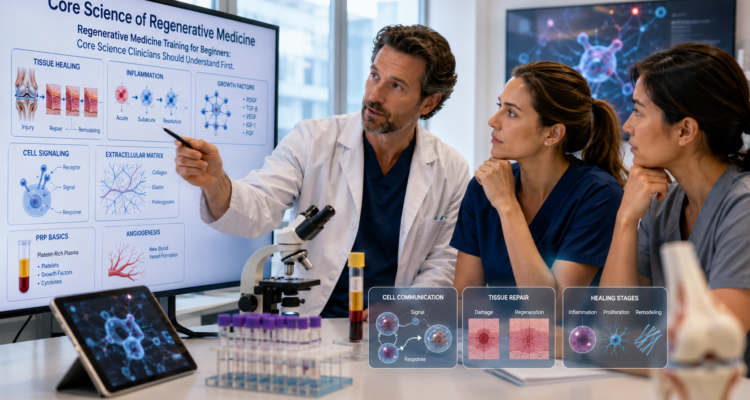
Regenerative medicine has become an increasingly important area of clinical education because it focuses on the biological processes involved in tissue repair, healing, cellular communication, and recovery. For physicians, registered nurses, nurse practitioners, physician assistants, dentists, medical students, and other eligible healthcare professionals, understanding these scientific foundations is essential before studying individual therapies or clinical protocols.
Beginners often encounter terms such as platelet-rich plasma (PRP), stem cells, extracellular vesicles, exosomes, peptides, growth factors, cytokines, angiogenesis, and extracellular matrix remodeling. These concepts are closely connected, but learning them as isolated treatment names can create gaps in clinical understanding. Effective regenerative medicine training therefore begins with the biology that explains how tissues respond to injury and how different interventions may interact with those processes.
Well-structured regenerative medicine courses should help healthcare professionals move beyond memorizing protocols and develop an understanding of why regenerative approaches are used, what biological mechanisms are being targeted, where the evidence is strongest, and where uncertainty remains. This foundation is particularly important because products and procedures grouped under the term “regenerative medicine” do not all have the same evidence base, regulatory status, mechanism, or clinical application. In the United States, the FDA regulates cellular and gene therapy products and uses a risk-based framework for human cells, tissues, and cellular and tissue-based products.
Regenerative medicine broadly concerns approaches designed to restore, replace, support, or regenerate damaged cells, tissues, or biological functions. The field intersects with cell biology, wound healing, molecular signaling, biomaterials, tissue engineering, immunology, and clinical medicine.
A critical distinction for beginners is the difference between repair and regeneration. Repair may restore tissue integrity through processes such as scar formation, while regeneration more closely restores the structure and function of the original tissue. Human tissues vary considerably in their regenerative capacity, and complete regeneration is not always biologically possible.
The National Institutes of Health describes regeneration as a complex biological process influenced by cellular behavior and tissue-specific mechanisms. Understanding those mechanisms helps clinicians evaluate regenerative claims more critically rather than assuming that every therapy marketed as “regenerative” produces true tissue regeneration.
Before clinicians focus on specific procedures, several scientific concepts deserve particular attention.
Tissue healing is not a single event. It involves coordinated biological stages that include hemostasis, inflammation, proliferation, and remodeling.
During hemostasis, platelets aggregate and participate in clot formation. Inflammation then recruits immune cells and signaling molecules that help remove damaged material and coordinate subsequent repair. The proliferative phase involves processes such as fibroblast activity, extracellular matrix production, epithelialization, and angiogenesis. Remodeling reorganizes newly formed tissue and extracellular matrix over time.
These phases overlap rather than operating as completely separate steps. Excessive or prolonged inflammation can also interfere with normal healing.
For beginners, this framework provides context for understanding why the timing of an intervention, tissue condition, patient health, and treatment objective can influence clinical decision-making.
Cells constantly communicate through biochemical signals. Growth factors, cytokines, chemokines, hormones, and other signaling molecules influence processes such as cell migration, proliferation, differentiation, inflammation, blood-vessel formation, and extracellular matrix production.
Important signaling molecules commonly discussed in regenerative medicine include platelet-derived growth factor (PDGF), vascular endothelial growth factor (VEGF), transforming growth factor beta (TGF-β), and various inflammatory cytokines.
A beginner does not necessarily need to memorize every signaling pathway. However, regenerative medicine training should establish enough molecular biology to help clinicians understand why biological treatments may behave differently between patients and why the concentration of a substance alone does not guarantee a predictable clinical response.
PRP provides a useful example of why basic science matters.
Platelets are best known for their role in hemostasis, but they also contain and release biologically active molecules involved in tissue-repair signaling. PRP is prepared from a patient’s own blood with the goal of concentrating platelets within plasma for particular clinical applications.
Research describes PRP as a biologically complex preparation containing platelets, plasma components, growth factors, cytokines, and extracellular vesicles. However, PRP preparations can differ significantly according to collection methods, centrifugation protocols, platelet concentration, leukocyte content, activation methods, patient characteristics, and handling.
That variability is one reason beginners should learn more than a procedural sequence. Understanding preparation science, biological variability, anatomy, patient assessment, and evidence appraisal is central to responsible clinical education.
The extracellular matrix, or ECM, is more than structural material surrounding cells. It provides a biological environment that influences cell adhesion, migration, signaling, differentiation, and tissue organization.
During tissue injury and healing, ECM components are broken down, synthesized, and reorganized. Fibroblasts play an important role in producing collagen and other matrix components, while enzymes participate in matrix remodeling.
Understanding the ECM helps clinicians connect concepts across wound healing, skin repair, scarring, aging, musculoskeletal biology, and other areas frequently discussed in regenerative medicine training.
Healing tissue requires an adequate blood supply. Angiogenesis, the formation of new blood vessels from existing vasculature, helps restore oxygen and nutrient delivery to repairing tissues.
VEGF and other signaling molecules contribute to this process. At the same time, tissue oxygen levels affect cellular behavior and healing pathways. This relationship demonstrates why regenerative outcomes cannot be explained by one molecule, product, or intervention alone.
Clinical outcomes occur within a biological system influenced by vascular health, inflammation, metabolism, tissue quality, age, comorbidities, medications, and other patient-specific variables.
Stem-cell biology is another foundational subject in regenerative medicine education.
Stem cells possess two defining characteristics: the ability to self-renew and the potential to differentiate into specialized cell types. Different categories of stem cells have different capabilities. Pluripotent stem cells can develop into many cell types, while adult or somatic stem cells typically have more limited differentiation potential.
Clinicians should also understand that the phrase “stem cell therapy” is sometimes used loosely in consumer marketing. Regulatory status depends on the specific product, processing, intended use, and indication.
The FDA continues to regulate products made from human cells and tissues and has warned about unapproved products marketed with unsupported treatment claims. This makes regulatory literacy an important component of regenerative medicine education in the United States.
Extracellular vesicles are membrane-bound particles released by cells that can transport proteins, lipids, nucleic acids, and other signaling molecules. Exosomes represent a commonly discussed subset within this broader area of cell-to-cell communication.
Their biological role has generated considerable research interest, but clinicians should distinguish emerging scientific evidence from authorized clinical products and established standards of care.
The FDA states that there are currently no FDA-approved exosome products and has issued safety communications regarding unapproved exosome products marketed for treating diseases or medical conditions.
For that reason, responsible regenerative medicine training online should teach evidence appraisal and regulatory context alongside biological mechanisms.
Beginning learners sometimes interpret inflammation as something that should always be suppressed. Biology is more complex.
Acute inflammation is a necessary part of normal tissue healing. Immune cells help clear damaged material, coordinate antimicrobial defenses, and release signals that influence later repair. Problems can develop when inflammation is excessive, poorly controlled, or prolonged.
The clinical question is therefore not simply whether inflammation is present, but whether the inflammatory response is appropriate for the stage of healing and the patient’s condition.
This distinction is essential when studying wound repair, tissue rejuvenation, recovery, and regenerative interventions.
Two patients undergoing the same procedure may not respond identically.
Age, metabolic health, vascular status, immune function, medications, smoking, nutritional status, chronic disease, tissue quality, and the severity of injury may all influence biological healing.
For autologous interventions such as PRP, variation in the patient’s own blood components may introduce additional variability. Recent reviews have emphasized that patient factors and technical preparation variables can affect PRP composition and potentially influence outcomes.
This is why regenerative medicine certification education should not be reduced to learning injection techniques. Patient assessment, contraindications, anatomy, biological mechanisms, treatment selection, documentation, and outcome monitoring are equally important components of clinical reasoning.
Regenerative medicine includes areas with different levels of scientific maturity. Healthcare professionals should therefore learn how to interpret research rather than treating every published study as equal.
Important questions include:
A mechanistic explanation can make a therapy scientifically interesting without proving that it is safe or effective for a particular clinical indication. Understanding that distinction is a central element of evidence-based regenerative medicine.
For beginners, the most productive learning sequence usually starts with anatomy, cellular biology, tissue healing, inflammation, growth factors, extracellular matrix biology, and clinical evidence evaluation. From there, learners can better understand modality-specific subjects such as PRP, peptides, microneedling, biologic products, and other regenerative approaches.
Regenerative medicine training online can make foundational learning more accessible, particularly for busy healthcare professionals, but theoretical education and procedural competency are not automatically equivalent. Any clinical procedure must remain within the learner’s professional scope of practice, applicable state law, institutional requirements, and appropriate standards of care.
Programs such as ABACT place multiple regenerative and related subjects within a broader educational curriculum, but clinicians evaluating any program should still consider scientific depth, faculty expertise, regulatory context, evidence quality, and the distinction between education and authorization to practice.
For healthcare professionals entering the field, regenerative medicine begins with biology—not with a particular product or procedure. Tissue healing, inflammation, cellular signaling, growth factors, extracellular matrix remodeling, angiogenesis, platelet biology, stem-cell science, and evidence evaluation provide the framework needed to understand more advanced subjects.
High-quality regenerative medicine courses should help clinicians connect these scientific principles with patient assessment, safety, regulation, and clinical reasoning. Establishing that foundation makes it easier to evaluate new therapies critically, understand why outcomes vary, and distinguish promising research from unsupported claims.
Beginners should first understand tissue healing, inflammation, cellular signaling, growth factors, extracellular matrix biology, angiogenesis, platelet function, basic stem-cell biology, and evidence-based medicine. These topics provide context for later modality-specific training.
Healthcare professionals generally already have foundational anatomy, physiology, and biological science knowledge, but regenerative medicine education may require a deeper review of cellular signaling, wound healing, immunology, tissue repair, and emerging biologic therapies.
Many theoretical components can be taught through regenerative medicine training online, including foundational science, patient assessment principles, treatment theory, evidence review, and regulatory concepts. Procedures requiring hands-on competence may require additional supervised practical training depending on the intervention and professional role.
Not automatically. Completing a course or receiving a certificate does not independently expand a professional license or scope of practice. Authority to perform a procedure depends on professional licensure, state regulations, training requirements, facility policies, supervision rules, and the specific treatment involved.
The field includes established medical applications, emerging technologies, experimental approaches, and products promoted beyond the available evidence. Clinicians who understand study design, biological plausibility, regulatory status, safety data, and clinical outcomes are better equipped to distinguish credible evidence from unsupported marketing claims.

