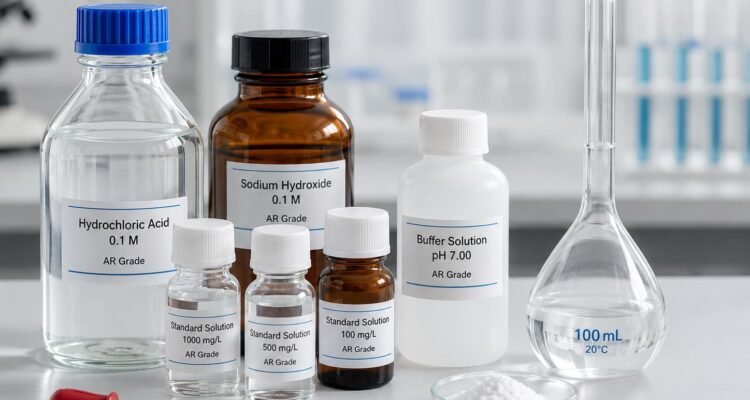
How Do You Choose the Right Analytical Chemicals?

How Do You Choose the Right Analytical Chemicals?

Introduction

Choosing the right analytical chemicals is essential for producing accurate, repeatable, and trustworthy laboratory results. The wrong grade, concentration, purity level, or reagent type can introduce contamination, interfere with measurements, and reduce confidence in the final data.

The Analytical Chemicals category supports testing, calibration, titration, trace analysis, quality control, method development, and scientific research across pharmaceutical, environmental, food, clinical, and industrial laboratories.

What Is the Purpose of the Analysis?

Start by defining exactly what the method needs to measure. Different analytical tasks require different chemicals, standards, and purity levels.

Analytical chemicals may be used for:

  • Measuring concentration
  • Detecting impurities
  • Determining pH
  • Identifying metals
  • Measuring density
  • Preparing calibration curves
  • Detecting titration endpoints
  • Validating analytical methods

A reagent suitable for routine preparation may not be pure enough for trace analysis. Similarly, a general buffer may not provide the accuracy required for instrument calibration.

Why Does Chemical Grade Matter?

Chemical grade indicates the quality and intended application of a reagent. High-sensitivity methods usually require chemicals with tighter impurity limits and stronger documentation.

Before choosing a grade, consider:

  • Method sensitivity
  • Detection limit
  • Instrument type
  • Sample complexity
  • Potential interference
  • Required traceability
  • Regulatory requirements

Using a higher grade than necessary may increase costs, while using an insufficient grade may compromise the analysis.

When Are Trace-Analysis Reagents Required?

Trace analysis measures very small quantities of elements or contaminants. Even minor impurities in water, acids, or alkaline solutions can create misleading readings.

The Acids, Alkaline Solutions and Water for Trace Analysis category supports ultra-trace testing where low background contamination is important.

These reagents may be appropriate for:

  • Environmental water testing
  • Metal contamination studies
  • Pharmaceutical impurity analysis
  • Semiconductor research
  • Elemental testing
  • Sensitive sample digestion

Containers, pipettes, and preparation surfaces should also be clean because high-purity chemicals cannot correct contamination introduced during handling.

Why Are High-Purity Products Important?

High-purity chemicals help reduce unwanted substances that may interfere with reactions, instrument signals, or sample preparation.

The High purity products category supports sensitive research and analytical workflows where reagent consistency is essential.

When evaluating purity, review the certificate of analysis, impurity profile, lot information, storage conditions, and expiry date. A purity percentage alone may not reveal whether a specific contaminant could affect the method.

How Do Indicators Support Analytical Testing?

Indicators produce a visible change when particular chemical conditions are reached. They are commonly used in titration, pH testing, redox analysis, metal determination, and qualitative detection.

The Indicators category includes pH indicators, redox indicators, metal indicators, ready-to-use solutions, and related detection reagents.

When choosing an indicator, check:

  • Expected endpoint
  • Required colour change
  • Sample colour
  • pH transition range
  • Solvent compatibility
  • Concentration
  • Storage stability

An unsuitable indicator can make the endpoint difficult to identify and produce inconsistent results.

When Should Special Buffer Solutions Be Used?

Buffers help maintain a controlled pH when acids, bases, samples, or reaction components are added. Stable pH is important because many instruments, enzymes, reactions, and detection methods are pH-sensitive.

The Special buffer solutions category supports pH control, calibration, biochemical testing, and method-specific laboratory work.

Choose a buffer according to:

  • Target pH
  • Working temperature
  • Buffering range
  • Sample composition
  • Instrument requirements
  • Biological compatibility
  • Required accuracy

A buffer should be used within its validated range and stored according to the product instructions.

How Are Density Standards Selected?

Density determination can support material identification, concentration checks, formulation control, and batch comparison.

The Density Determination category supports calibration and reference testing for densitometry and specific-gravity measurements.

When selecting a density reference, confirm the certified value, reference temperature, measurement uncertainty, container condition, and compatibility with the instrument.

Temperature control is especially important because density can change when the temperature changes.

Why Does Accurate Liquid Handling Matter?

Correct chemical selection alone cannot guarantee reliable results. Errors during dilution, pipetting, sampling, or transfer can change concentration and affect the complete method.

The Liquid Handling category supports accurate dispensing, pipetting, sampling, filling, and solution preparation.

Good practice includes using calibrated equipment, clean containers, correct volumetric procedures, and clearly labelled solutions.

What Documentation Should Be Checked?

Before using an analytical chemical, review:

  • Certificate of analysis
  • Batch or lot number
  • Purity specification
  • Concentration
  • Traceability information
  • Expiry date
  • Storage instructions
  • Safety documentation
  • Measurement uncertainty where relevant

Strong documentation helps laboratories investigate unexpected results and demonstrate that suitable materials were used.

Common Selection Mistakes

Avoid:

  • Choosing by price alone
  • Using the wrong chemical grade
  • Ignoring method sensitivity
  • Using expired standards
  • Selecting an incompatible solvent
  • Preparing inaccurate dilutions
  • Overlooking storage requirements
  • Reusing contaminated containers
  • Failing to document batch numbers

Testing a new reagent within the complete method before routine use can prevent larger analytical problems.

Conclusion

Choosing the right analytical chemicals requires matching the reagent to the method, instrument, sample, sensitivity, purity requirement, and quality-control objective.

High-purity chemicals support sensitive analysis, trace-analysis reagents reduce contamination risk, indicators improve endpoint detection, buffers maintain controlled pH, and density standards support reliable physical measurements.

By checking chemical grade, documentation, compatibility, storage, preparation, and handling requirements, laboratories can reduce interference, improve repeatability, and produce more dependable analytical results.

leave your comment


Your email address will not be published. Required fields are marked *


news-1701

yakinjp

yakinjp

rtp yakinjp

yakinjp

yakinjp

yakin jp

yakinjp id

maujp

maujp

maujp

\

sabung ayam online

sabung ayam online

SLOT MAHJONG

sabung ayam online

article 0000141

article 0000142

article 0000143

article 0000144

article 0000145

article 0000146

article 0000147

article 0000148

article 0000149

article 0000150

article 0000151

article 0000152

article 0000153

article 0000154

article 0000155

article 0000156

article 0000157

article 0000158

article 0000159

article 0000160

article 0000161

article 0000162

article 0000163

article 0000164

article 0000165

article 0000166

article 0000167

article 0000168

article 0000169

article 0000170

article 0000171

article 0000172

article 0000173

article 0000174

article 0000175

article 0000176

article 0000177

article 0000178

article 0000179

article 0000180

article 0000181

article 0000182

article 0000183

article 0000184

article 0000185

article 0000186

article 0000187

article 0000188

article 0000189

article 0000190

article 00046

article 00047

article 00048

article 00049

article 00050

article 00051

article 00052

article 00053

article 00054

article 00055

article 00056

article 00057

article 00058

article 00059

article 00060

article 00061

article 00062

article 00063

article 00064

article 00065

article 00066

article 00067

article 00068

article 00069

article 00070

article 00071

article 00072

article 00073

article 00074

article 00075

article 00076

article 00077

article 00078

article 00079

article 00080

article 00081

article 00082

article 00083

article 00084

article 00085

article 00086

article 00087

article 00088

article 00089

article 00090

article 00091

article 00092

article 00093

article 00094

article 00095

article 888836

article 888837

article 888838

article 888839

article 888840

article 888841

article 888842

article 888843

article 888844

article 888845

article 888846

article 888847

article 888848

article 888849

article 888850

article 888851

article 888852

article 888853

article 888854

article 888855

article 888856

article 888857

article 888858

article 888859

article 888860

article 888861

article 888862

article 888863

article 888864

article 888865

articel 000000171

articel 000000172

articel 000000173

articel 000000174

articel 000000175

articel 000000176

articel 000000177

articel 000000178

articel 000000179

articel 000000180

articel 000000181

articel 000000182

articel 000000183

articel 000000184

articel 000000185

articel 000000186

articel 000000187

articel 000000188

articel 000000189

articel 000000190

articel 000000191

articel 000000192

articel 000000193

articel 000000194

articel 000000195

articel 000000196

articel 000000197

articel 000000198

articel 000000199

articel 000000200

articel 000000201

articel 000000202

articel 000000203

articel 000000204

articel 000000205

articel 000000206

articel 000000207

articel 000000208

articel 000000209

articel 000000210

articel 000000211

articel 000000212

articel 000000213

articel 000000214

articel 000000215

articel 000000216

articel 000000217

articel 000000218

articel 000000219

articel 000000220

article 2000136

article 2000137

article 2000138

article 2000139

article 2000140

article 2000141

article 2000142

article 2000143

article 2000144

article 2000145

article 2000146

article 2000147

article 2000148

article 2000149

article 2000150

article 2000151

article 2000152

article 2000153

article 2000154

article 2000155

article 2000156

article 2000157

article 2000158

article 2000159

article 2000160

article 2000161

article 2000162

article 2000163

article 2000164

article 2000165

article 2000166

article 2000167

article 2000168

article 2000169

article 2000170

article 2000171

article 2000172

article 2000173

article 2000174

article 2000175

article 2000176

article 2000177

article 2000178

article 2000179

article 2000180

article 2000181

article 2000182

article 2000183

article 2000184

article 2000185

article 838000421

article 838000422

article 838000423

article 838000424

article 838000425

article 838000426

article 838000427

article 838000428

article 838000429

article 838000430

article 838000431

article 838000432

article 838000433

article 838000434

article 838000435

article 838000436

article 838000437

article 838000438

article 838000439

article 838000440

article 838000441

article 838000442

article 838000443

article 838000444

article 838000445

article 838000446

article 838000447

article 838000448

article 838000449

article 838000450

article 838000451

article 838000452

article 838000453

article 838000454

article 838000455

article 838000456

article 838000457

article 838000458

article 838000459

article 838000460

news-1701