Welcome To DWT Listing Theme
-
All Locations :

Welcome To DWT Listing Theme
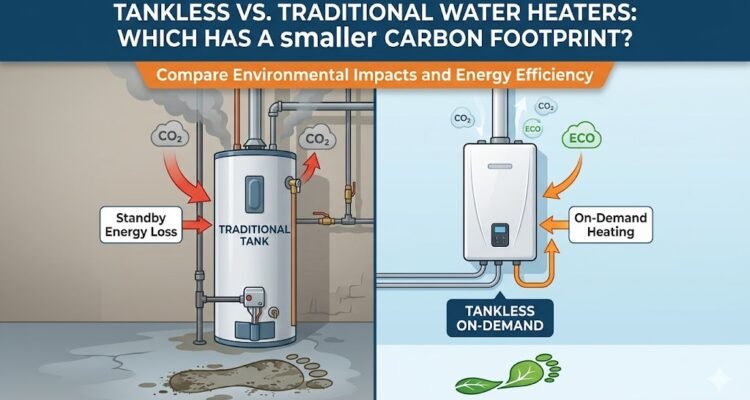
Residential water heating represents one of the largest sources of energy consumption in modern households. As global energy standards tighten and environmental sustainability becomes a primary focus for property owners, evaluating the mechanical efficiency of home appliances is crucial. Deciding between a traditional storage tank and a tankless on-demand system has a direct, measurable impact on a home’s overall greenhouse gas emissions.
To determine which water heater offers the smallest carbon footprint, the operational mechanics, lifecycle longevity, and energy source requirements of both technologies must be carefully analyzed.
Traditional water heaters operate on a continuous storage model. These systems heat and maintain a large volume of water—typically between 40 and 60 gallons—inside an insulated tank 24 hours a day. Because heat continuously escapes through the tank walls and flue, the burner or electrical element must cycle on repeatedly to keep the water hot, even when the property is empty. This phenomenon is known as standby heat loss and is a significant source of avoidable energy waste.
In contrast, tankless water heaters eliminate the storage tank. Cold water flows through a high-efficiency heat exchanger only when a hot water tap is opened. This demand-response mechanism ensures that energy is consumed strictly during actual usage periods, completely removing standby energy losses from the carbon equation.
According to data compiled by the U.S. Department of Energy, the thermal efficiency variations between these two systems correlate heavily with daily consumption volumes:
Low-Usage Households (41 gallons or less daily): On-demand tankless systems achieve 24% to 34% greater energy efficiency compared to conventional storage tanks.
High-Usage Households (around 86 gallons daily): The efficiency advantage of tankless systems ranges from 8% to 14% due to their continuous, high hot water demand.
A side-by-side comparison highlights the structural and operational differences that influence environmental performance:
| Feature Evaluation | Traditional Storage Tank | Tankless On-Demand System |
| Standby Heat Loss | High (Continuous 24/7 cycling) | None (Operational only when active) |
| Typical Energy Efficiency | 60% – 70% | 82% – 95% |
| Average Operational Lifespan | 8 – 12 Years | 20+ Years |
| Primary Environmental Impact | Higher cumulative carbon emissions | Significantly reduced fuel consumption |
The net carbon footprint of a water heating system depends significantly on whether it runs on natural gas, propane, or electricity.
Gas-fired tankless models utilize advanced modulating burners to adjust heating power dynamically based on water flow rates. This precision reduces the overall volume of natural gas burned per gallon of water delivered. However, maintaining peak combustion efficiency requires regular oversight, making professional gas hot water maintenance an essential practice to ensure the system does not experience performance degradation over time.
Electric tankless models present a different environmental profile. While the efficiency of electric units is inherently high, the actual carbon footprint depends entirely on the local power grid. If a home is connected to an electrical grid powered by renewable sources like solar or wind, an electric tankless system can achieve a near-zero carbon emission status.
Technical Insight: Moving away from standard draft storage tanks toward high-efficiency on-demand configurations aligns directly with modern building codes designed to minimize residential environmental footprints.
A comprehensive assessment of a carbon footprint must include the manufacturing, shipping, and disposal lifecycle of the appliance. Traditional storage tanks are highly susceptible to internal corrosion and sediment buildup, leading to an average operational lifespan of just 8 to 12 years.
Tankless systems are engineered with easily replaceable components and are less prone to catastrophic structural failures. With an expected lifespan exceeding 20 years, a single tankless unit outlasts two traditional water heaters. This extended durability translates into a substantial reduction in material waste, manufacturing emissions, and landfill accumulation over the long term.
Achieving the absolute lowest carbon footprint requires a system that is perfectly calibrated to the specific flow rate and layout of a home. Consulting an experienced provider like peak flow plumbing ensures that the selected unit matches the precise demands of the household without wasting resources.
Whether a homeowner is looking to replace an aging storage unit or simply schedule a general plumbing service to analyze current appliance performance, investing in modern, high-efficiency water heating technology represents a definitive step toward a more sustainable, low-emission household.

