
Google Ads Management Services: What Does an Agency Actually Do?
Google Ads Management Services: What Does an Agency Actually Do?
Google Ads Management Services help businesses reach potential customers through targeted paid advertising on Google Search, Display, YouTube, and other Google advertising placements. A professional Google Ads agency manages keyword research, campaign setup, audience targeting, bidding strategies, conversion tracking, and performance reporting to help businesses use their advertising budget effectively.
In this guide, we explain what Google Ads management services include, how agencies optimize campaigns, and what businesses should evaluate before hiring an agency.
Many business owners start a campaign, see clicks, and get few real enquiries. The problem is rarely the platform. It is usually the ongoing work: which searches trigger your ads, whether enquiries are being tracked, and what happens to the budget week after week.
This guide explains what Google Ads management services actually cover, what an agency does each month, what it costs, what it cannot fix, and how to judge whether the work is being done properly.
What Are Google Ads Management Services?
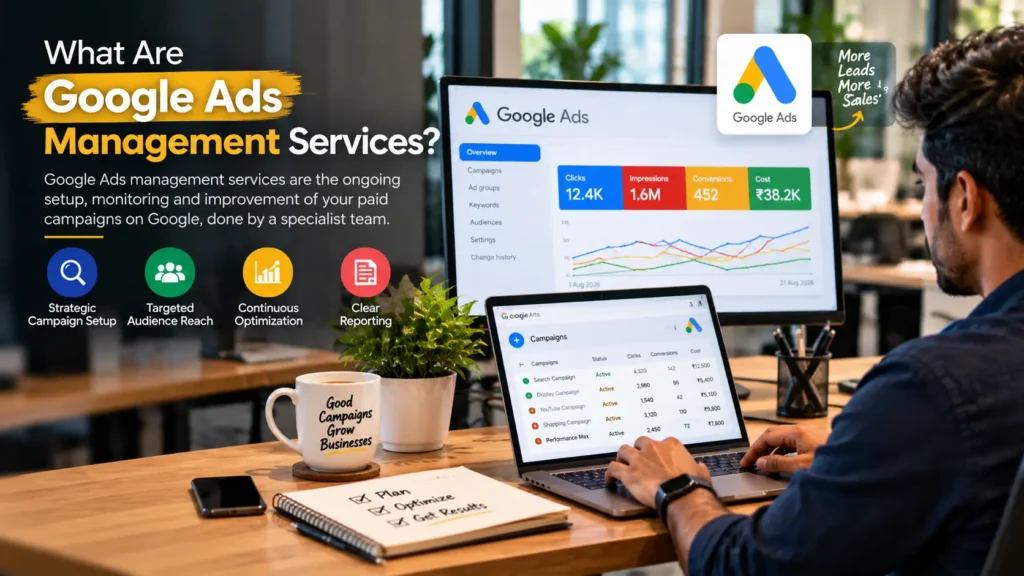
Google Ads management services are the ongoing setup, monitoring and improvement of your paid campaigns on Google, done by a specialist team. The agency decides where your ads show, what they say, how much you bid, and how results are measured. You decide the goals, the offer and the budget.
The important word is ongoing. Launching a campaign is a few days of work. Making it profitable is months of small corrections.
How the Work Flows
- Goal setting. The agency asks what a result is worth to you: an admission enquiry, a room booking, a table reservation, a phone call.
- Research. Keywords, competitors, locations and the questions your customers type.
- Build. Account, campaigns, ads, tracking.
- Launch and watch. Early data shows what is working and what is wasting money.
- Improve. Weekly and monthly changes to keywords, ads, bids and pages.
- Report. Results in business terms, not just clicks.
Who Needs Professional Management?
- Local and service businesses that need calls and enquiries from a specific area.
- Education businesses such as coaching centres, colleges and schools that want admission enquiries in a fixed season.
- Hotels and restaurants that want direct bookings, calls and visits instead of depending only on listing platforms.
- Online stores that want to sell products through Google.
- Established companies with large budgets where small inefficiencies cost real money.
If you spend very little and have time to learn, you can run Google Ads yourself. Management pays off when the budget, or the time cost, is big enough to justify an expert.
What Google Ads Management Services Include
Keyword Research and Search Intent
Keywords are the searches that can trigger your ads. An agency does more than pick popular ones. It separates people ready to act (“admission in BBA college Jaipur”) from people just browsing (“what is BBA”), groups keywords by theme, studies what competitors bid on, and builds a list of negative keywords to block irrelevant searches.
Account Setup and Campaign Structure
This covers account settings, campaign and ad group structure, location and language targeting, device settings and the launch itself. Good structure matters because it controls which ad appears for which search, and how cleanly you can see what works.
One point to settle early: the Google Ads account should belong to you. The agency should work through manager access.
Ad Copy and Testing
An agency writes headlines, descriptions and calls to action that match what people searched for, then tests versions against each other. The aim is not clever wording. It is getting the right person to click and then take action. The copy on the page they land on matters just as much, and that is where content writing support helps.
Budget and Bidding Strategy
Your daily budget limits spend. Your bidding strategy decides how Google spends it, for example aiming for the most conversions or for a target cost per lead. The agency picks a strategy that fits your data, watches for overspend, and moves money toward campaigns that bring results. Automated bidding only works well when your conversion data is accurate, which leads to the next point.
Conversion Tracking and Reporting
Without tracking, you only know someone clicked. An agency sets up conversion tracking for form submissions, phone calls, WhatsApp clicks, bookings or purchases, and connects it with Google Analytics. Reports should show leads and cost per lead, not only impressions and clicks.
Campaign Types an Agency Can Manage
| Campaign type | What it does | Best suited for |
|---|---|---|
| Search | Shows text ads to people actively searching | Almost every business; usually the starting point |
| Display | Shows image ads across websites and apps | Awareness and remarketing |
| YouTube | Shows video ads to chosen audiences | Brand building, visual products, remarketing |
| Shopping | Shows products with image and price, using a product feed | Online stores |
| Performance Max | Uses Google’s channels automatically toward the conversion goals you set | Businesses with solid tracking and creative assets |
Start with Search unless you have a clear reason not to. Performance Max gives you less control over where ads appear, so it needs good conversion data and close monitoring. Display and YouTube need strong visuals, which is where creative design support helps.
How Management Improves Campaign Performance
Search Term Analysis and Negative Keywords
The search terms report shows the actual searches that triggered your ads. It often contains surprises: job seekers, free-service hunters, students, or unrelated phrases. Reviewing it regularly and blocking those terms with negative keywords is one of the most direct ways to cut wasted spend.
Landing Page and Conversion Rate Optimization
A good ad sends people to a page that is easy to act on. The agency checks that the page matches the ad, loads fast on mobile, has a clear call to action and a short form. If the page is weak, better ads will not fix it. Sometimes the fix needs website development work, not ad changes.
Audience Targeting and Remarketing
Location targeting keeps spend inside areas you can serve, from one city to the whole country. Audience settings and remarketing bring back people who visited but did not enquire. Remarketing needs enough site visitors to work, so it usually comes after the basics.
Key Metrics Used in Google Ads Management Services
Effective Google Ads management services focus on measurable campaign performance rather than clicks alone. Agencies monitor these key metrics:
- Click-Through Rate (CTR): The percentage of ad impressions that result in clicks.
- Cost Per Click (CPC): The average amount paid for each ad click.
- Conversion Rate: The percentage of ad interactions that result in a desired action.
- Cost Per Conversion: The average advertising cost for each tracked conversion.
- Return on Ad Spend (ROAS): The revenue attributed to advertising divided by advertising spend.
For example, if a campaign spends ₹10,000 and generates 20 conversions, its cost per conversion is ₹500. This is a calculated example, not a benchmark or a promise of results. Actual performance depends on the industry, competition, campaign setup, and conversion quality.
What the First 90 Days Look Like
Timelines vary, but a sensible agency engagement tends to follow this pattern.
- Weeks 1 to 2: Audit and setup. Goals, tracking, account access, keyword research, campaign build. Tracking is tested before money is spent.
- Weeks 3 to 6: Learning. Ads collect data. The agency removes irrelevant searches, pauses weak keywords and tests ad versions. Results are uneven in this period, and that is normal.
- Weeks 7 to 12: Tuning. With real conversion data, bidding, budgets and pages are adjusted. This is when you should start seeing a clear picture of cost per qualified lead.
Be wary of anyone promising exact results in the first few days. Ads can go live quickly, but reliable results need data.
Benefits, and What an Agency Cannot Fix
What good management gives you
- Less wasted spend through regular search term review.
- Better lead quality through tighter targeting.
- Time back, because setup, testing and reporting are handled.
- Decisions based on data, not guesses.
What an agency cannot fix
- A weak offer. If your fees or prices are not competitive, ads will not change that.
- A poor website. Slow or confusing pages lose enquiries.
- Slow follow-up. If leads are called back after two days, most are gone.
- Unrealistic budgets. A tiny budget in a competitive market gives little data.
A good agency will tell you when the problem is on your side of the table.
How Much Do Google Ads Management Services Cost?
Agency prices in India vary widely, so use the structure below to compare quotes instead of relying on a single number. Ask every agency for a written quote.
Common Fee Models
| Model | How it works | Watch out for |
|---|---|---|
| Flat monthly fee | Fixed amount for a defined scope | Make sure reporting and calls are included |
| Percentage of ad spend | Fee grows with your budget | Can reward higher spend, not better results |
| Hybrid | Base fee plus a share of spend | Check the exact formula |
| Performance-based | Paid per qualified lead or sale | Rare; needs strict lead definitions |
Fee depends on campaign complexity, competition in your industry, number of campaigns, tracking needs and how much support you get.
Management Fee vs. Advertising Budget
These are two separate costs.
- Management fee: paid to the agency for its work.
- Ad spend: paid to Google, directly from your Google Ads account, for the clicks.
If an agency quotes one number, ask which of the two it covers. Confusing them is a common source of disputes.
How to Set a Starting Budget
Start from what a lead is worth, not from what feels comfortable.
Hypothetical example: a coaching centre earns ₹20,000 from each enrolled student and enrols 1 in every 5 enquiries. Each enquiry is then worth about ₹4,000 in revenue. If the profit margin is 40%, each enquiry is worth about ₹1,600 in profit. Paying ₹1,500 per enquiry leaves almost nothing. Paying ₹600 per enquiry works.
Then check three things:
- Is the cost per lead you need realistic for your market?
- Is the budget big enough to produce enough clicks to learn from?
- Can you handle the volume of enquiries?
How to Choose the Right Google Ads Agency
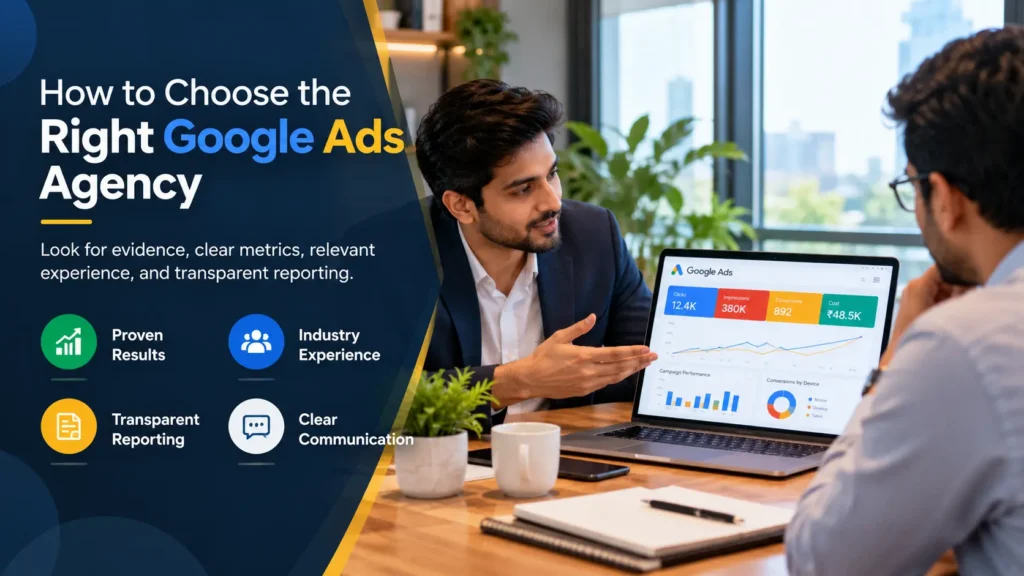
Look at evidence, not promises. Ask for examples relevant to your sector, and ask how they define a result. Check that they can explain their metrics in plain language and show a sample report.
Questions to Ask Before Hiring
- Will the Google Ads account be in my name, and will I have admin access?
- What exactly does the fee include, and what does it not include?
- How is conversion tracking set up and tested?
- How often will you review search terms and make changes?
- What will the reports show, and how often will we meet?
- What is the notice period if I want to leave?
- What results are realistic for my budget? (Be careful if the answer is a guarantee.)
Red Flags
- Guaranteed rankings, leads or sales.
- The agency owns the account and will not share access.
- Reports show only clicks and impressions.
- No clear answer on tracking.
- Pushing you to raise spend before the data supports it.
Common Google Ads Management Mistakes
- Broad, irrelevant keywords. They attract clicks from people who will never buy.
- Never reviewing search terms. Waste builds quietly.
- No conversion tracking. Clicks do not prove enquiries.
- Sending traffic to the homepage. Visitors should land on a page built for the ad’s promise.
- Judging too early. A few days of data rarely supports a decision.
Are Google Ads Management Services Worth It for Small Businesses?
Often yes, but not always. The test is simple: does the extra leads or savings exceed the management fee and ad spend? That depends on competition, budget, offer quality, tracking and the landing page, not on the agency alone.
When to Hire Help
- You are spending money and cannot say which clicks became enquiries.
- Lead quality is inconsistent.
- You have no time to review and adjust campaigns.
- You tried it yourself and results stalled.
How to Measure Results
Track qualified leads, cost per qualified lead, conversion rate, sales closed and ROAS where it applies. Review them against the numbers you set before the campaign started. For deeper lead flow beyond ads, see our lead generation approach.
Google Ads also works best alongside other channels. Paid search brings fast intent-driven traffic, while SEO builds results that last without paying per click, and Meta ads and social media marketing reach people who are not searching yet. Our wider digital marketing services can combine them.
Conclusion
Google Ads management is not just setting up campaigns. It is a loop of research, tracking, testing and correction, measured against what a customer is worth to your business. The best results come from accurate tracking, a strong offer, a good landing page and patience for the data to build.
Looking to improve your Google Ads campaigns? Contact Advide Solutions to discuss your business objectives, advertising strategy and campaign optimization requirements.
6. FAQ Section
What are Google Ads management services?
They are the ongoing planning, setup, monitoring and improvement of your Google Ads campaigns by a specialist team. This includes keyword research, ad writing, bidding, budget control, conversion tracking and reporting.
How much do Google Ads management services cost?
It depends on scope, competition and how much support you need. Common models are a flat monthly fee, a percentage of ad spend, or a mix. Ask for a written quote that states what is included.
How long does it take to see results from Google Ads?
Ads can start showing within days of approval, but reliable results usually need a few weeks to a few months of data. The time depends on your budget and how many conversions the campaign collects.
Do Google Ads management services include advertising spend?
No. The management fee pays the agency. Ad spend is paid to Google for the clicks, usually directly from your Google Ads account.
Can Google Ads management services generate quality leads?
They can improve lead quality through better keywords, targeting, ads and landing pages. The final result also depends on your offer, pricing, website and how quickly you follow up.
What should I look for in a Google Ads management agency?
Relevant examples, clear reporting that includes leads and not just clicks, a tested tracking setup, account ownership in your name, and honest expectations without guarantees.
Can small businesses benefit from Google Ads management services?
Yes, if the budget is large enough to collect useful data and each lead has enough value to cover the costs. Very small budgets in competitive markets may be better spent first on the website or local SEO.