
China’s Parallel Internet, Explained Category by Category
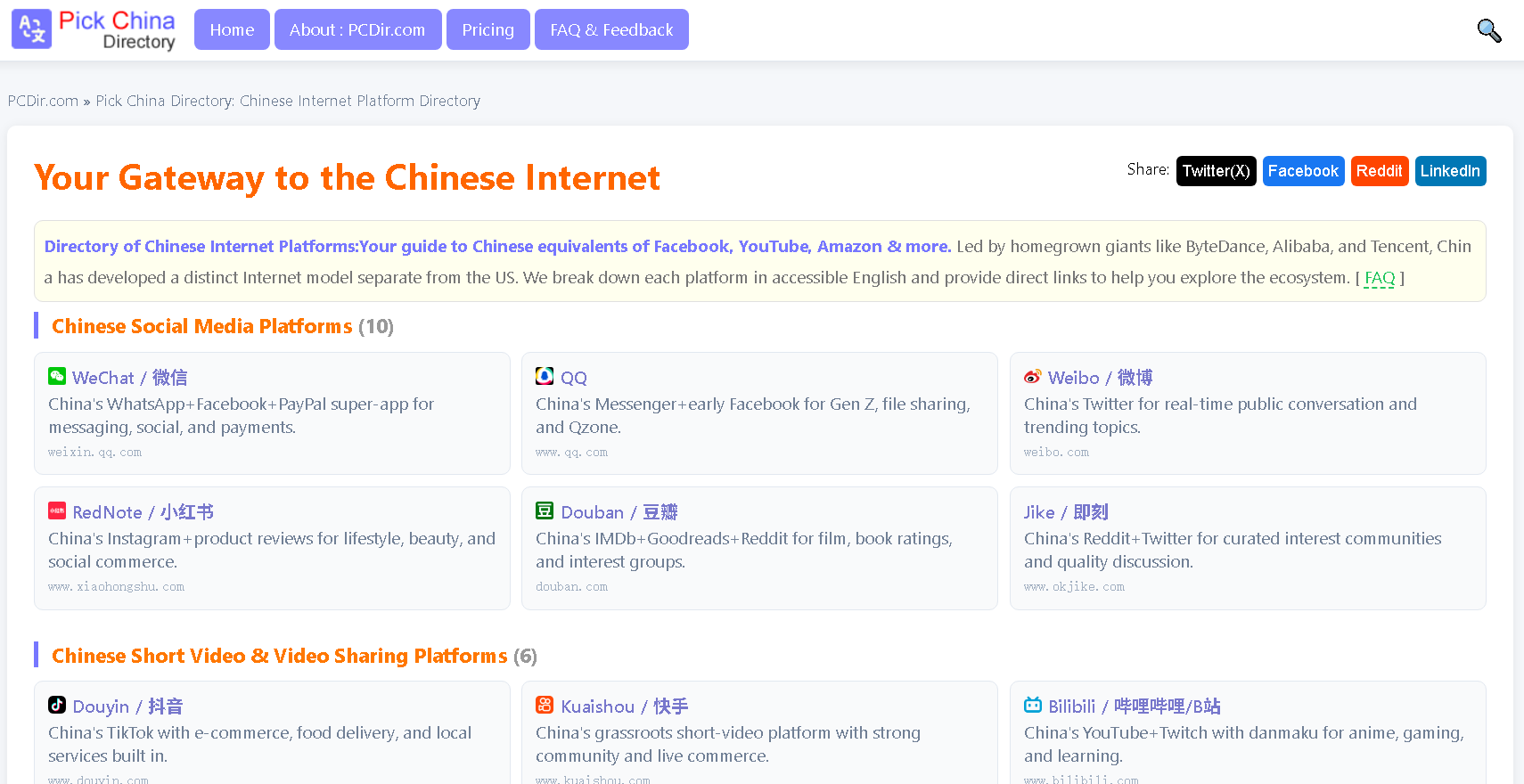
For most readers outside the country, the Chinese internet is a list of names they have heard but never opened: WeChat, Douyin, Xiaohongshu, Bilibili, Pinduoduo. Each one is usually introduced as “China’s version of” something familiar — China’s WhatsApp, China’s TikTok, China’s Instagram. That shorthand is useful, but it hides the more interesting fact: China runs a full parallel consumer internet, with its own search engines, app stores, payment rails, streaming platforms, and AI assistants. Understanding it category by category is faster than learning apps one at a time, and a maintained English guide to the Chinese internet makes that mapping far less confusing.
Why a Separate Ecosystem Exists
The split was not part of some original plan. In the late 1990s and early 2000s, Chinese startups openly cloned Silicon Valley models: Baidu mirrored Google, Youku mirrored YouTube, Taobao mirrored eBay. Two forces then pushed the ecosystems apart. First, the largest American social and search platforms stopped operating on the mainland, which removed the incumbents that would otherwise have set the defaults. Second, domestic regulation around content, payments, gaming approvals, and data storage meant that surviving firms had to build compliance, moderation, and identity systems that had no direct Western counterpart. The result is that a question like “what is China’s Amazon” rarely has a single answer — parcel e-commerce alone spans Taobao, JD, and Pinduoduo, each with a different price tier, logistics model, and shopper base.
Mobile Came First, Websites Came Second
The other great divergence is hardware. China crossed into a smartphone-majority market while many services were still young, so companies designed for the handset and treated the desktop site as an afterthought. WeChat is the clearest example: its Official Accounts and mini-programs let merchants, publishers, and government offices operate entirely inside the chat application, and some small businesses never build a standalone website at all. Short-video commerce followed the same path — Douyin hosts product discovery, livestream selling, and checkout in one feed, while the equivalent Western journey still bounces between three or four apps. Anyone arriving with desktop-era assumptions, such as “every serious company has a polished homepage,” will repeatedly find that the website is the stalest artifact of an otherwise lively service.
Reading the Map by Category
The fastest way to orient yourself is to walk the categories the way a local would. Messaging and social cover WeChat, QQ, Weibo, Xiaohongshu, and Douban, which split duties that in the West collapse into two or three giants: chat, public blogging, lifestyle reviews, and interest-group discussion each have a separate home. Video is similarly split — Bilibili owns the anime, gaming, and commentary crowd; iQIYI, Tencent Video, and Youku divide long-form drama; Douyin and Kuaishou own short video and live commerce. Music, podcasting, and audiobooks run through QQ Music, NetEase Cloud Music, and Ximalaya. Gaming spans PC blockbusters, mobile hits, and esports leagues under publishers like Tencent and NetEase. Two newer shelves deserve attention: AI chatbots and image tools from Baidu, Alibaba, ByteDance, and Moonshot, and the web-fiction and comics platforms — Qidian, Jinjiang, Kuaikan — that feed half the country’s screen adaptations.
How to Check Claims Without Reading Chinese
Fast-moving facts are where guides go stale: monthly active users, app-store availability outside China, corporate ownership. A practical habit is to anchor every claim to the platform’s own site or a dated announcement, and to drop numbers that cannot be verified rather than repeating them. Access questions also need direct testing — some services load fine abroad, some need a local phone number for registration, and a few retire their websites while the app keeps working. Dated entries and correction channels beat confident-sounding precision. When a fact matters, confirm it against the primary source before quoting it, because in this ecosystem last year’s screenshot is usually wrong.